
#22 The Butterfly Process
Your collaborators need a map. You need a compass. The butterfly keeps you focused on moving in the right direction

Some workshops feel purposeful — every phase building on the last, the room moving with a sense of direction. Others feel like a blur: you ran perfectly decent activities, the energy was fine, and still, walking out, you find yourself wondering what, exactly, just happened.
The activities aren’t usually the problem. The problem is the logic that sits above them.
If you read Issue #7, you might remember Dream, Map, Distil, Prioritise — every activity you’ll ever run in a workshop sits inside one of those four categories. In Issue #21, I talked about the difference between a tool, a method and a process. Today, I want to share the process that sits above those four types in my own practice. The logic I use to understand how workshops actually move.
I call it the Butterfly.
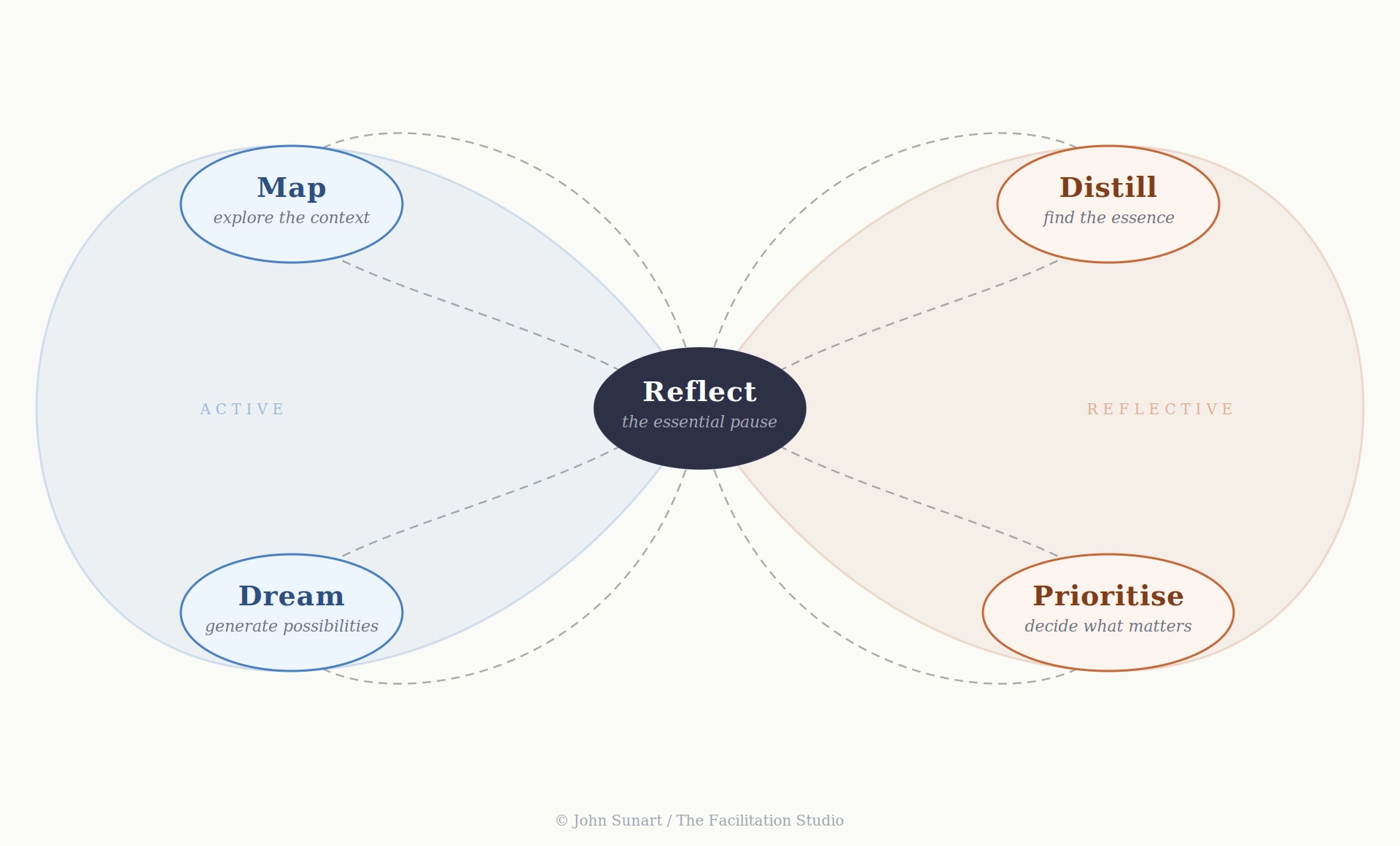
Hopefully, the reason for the name is self-evident. Two wings, two types of thinking. The left wing is where the active work happens: Dreaming and Mapping — generating, exploring, laying things out. The right wing is where the reflective work happens: Distilling and Prioritising — making sense of what you’ve got, deciding what it means, and where to go next.
And right at the centre, where both wings meet, is Reflect. Every single movement between one type of work and another passes through that centre point in the facilitator’s mind. You don’t go from Dream straight to Prioritise. You go Dream — Reflect — Prioritise. You don’t go from Map to Distil without stopping. You go Map — Reflect — Distil. Every time. Without exception.
Reflect isn’t a phase in the way the four types are phases. It’s not a workshop activity you schedule into the agenda. It’s the moment you pause, look at what’s just happened, and consciously decide what comes next. It’s you, as the facilitator, saying: right — what have we just learned, and are we ready to move on?
What a Reflect point actually looks like
In my own practice, a Reflect point follows a fairly consistent shape. Not a script, but a set of directions I work through each time.
First, I name what we’ve just done and why. Not a summary of the outputs — a reminder of the purpose of the phase.
“We’ve just spent an hour mapping the current process because we needed to understand what’s actually happening now, before we can think about what should be happening.” That lands differently than “okay, so we’ve done the mapping.”
Then I name the outcome. What did we actually produce or learn? This is the moment the room gets to feel the weight of what they’ve made together.
“We’ve learned that there are way more humans in the loop than we expected. This service is being held together by a whole lot of people who aren’t in our documentation.”
Then I name what we’re moving to next, and why that makes sense given what we’ve just done. The logic of the transition is the whole point of Reflect — it’s the bridge between the last phase and the next.
“So we’re going to Distil what we’ve learned into key opportunity points — we need to make sense of what we’ve found before we can start thinking about what to do about it.”
Then directions — what will physically happen next, how it will work, what’s expected.
“We’re going to work in pairs from different parts of the organisation for the next twenty minutes. Each pair takes one section of the map. Your job is to identify the three moments that matter most in your section — the ones that, if they broke, the whole thing would break.”
Then exceptions — anything that doesn’t apply to everyone? Call that out rather than letting it derail the next phase.
“If you were involved in writing the original documentation, I’d love you to pair with someone who wasn’t — we want a mixture of levels of awareness.”
Then I take questions. And only then do we begin.
The whole thing takes two or three minutes. But those minutes are doing an enormous amount of structural work — they’re the reason the next phase starts with momentum rather than confusion.
The Butterfly, the Double Diamond, and where this came from
The Butterfly didn’t appear from nowhere. It grew partly from the Double Diamond — the Design Council’s framework for design and innovation — and partly from a simpler cyclical process called Think, Dream, Do. The reflective/active distinction owes something to academic frameworks I first encountered at the Institute of Design Innovation. Knowing the lineage helps you see where the ideas connect.
The Double Diamond is the only linear process of the three, and that linearity is genuinely useful — in a different way. I might be thinking in Butterfly loops, but I’ll often explain the overall shape of a day to collaborators using the Double Diamond, because it gives them a direction of travel. A beginning, a middle, an end. People find that reassuring when they’re standing in front of a wall of Post-its wondering what happens next. And if you squint at the four activity types, the resemblance is obvious: Map, Distil, Dream and Prioritise map pretty cleanly onto Discover, Define, Develop and Deliver.
As a facilitator, you need to embrace non-linearity — and that’s genuinely hard to do with a linear model as your only mental map. Real workshops loop back, revisit, leap forward and retreat. The Butterfly lets you lean into that. It doesn’t tell you which direction to go; it tells you that every direction passes through the same point.
The Double Diamond gives your collaborators a map they can read. The Butterfly gives you a compass. Use them both.
Working with the Butterfly
Once you start running mental Butterfly loops in a workshop, you’ll find it sharpens your instincts. You’ll feel the pull when a room tries to leap from Dream straight to Prioritise. You’ll notice the moment a group needs to stop and reflect before they’re ready to move. You’ll start designing your sessions around the transitions, not just the activities.
That, I think, is what separates a facilitator from someone who runs workshops. Anyone can fill two hours with activities. The facilitator knows where the room is on the wings — and when it’s time to bring everyone back through the centre.
Until next time, happy facilitating!